
Single Leg Stability Training: Why Your Big Toe Matters (Mobo Board Guide)
If you've ever felt shaky standing on one leg, rolled an ankle more than once, or hit a plateau in your balance training, the problem might not be strength at all — it might be your big toe.
At Pure Movement in Portage, MI, single leg stability training is a foundational piece of how we work with runners, athletes, and clients focused on fall prevention and long-term mobility. And more often than not, the missing piece isn't a stronger core or a harder balance drill — it's whether the big toe is actually doing its job.
Why Single Leg Stability Matters
Every time you run, cut, climb stairs, or catch yourself from a stumble, you're relying on single leg stability. It's essential for runners and athletes in cutting or pivoting sports, valuable for older adults working on fall prevention, and a key piece of rehab after an ankle, knee, or hip injury. Poor single-leg control doesn't just limit athletic performance — it's one of the most common threads we see in clients dealing with recurring ankle sprains, knee pain, or a general sense of instability.
The Real Problem: Two Compensation Patterns
When we assess single leg stability, we typically see one of two patterns.
The first is shifting weight away from the big toe. The foot loses its primary stabilizer, and the ankle and lower leg end up compensating for a job the big toe should be doing.
The second is collapsing into the arch and the big toe. This might sound like the opposite problem, but it creates a different issue: rigidity. Instead of an adaptable, responsive foot that can react to changing terrain or shifting balance, the foot locks up.
Both patterns lead to the same downstream effect — compensation up the chain through the ankle, knee, and hip, and a higher risk of injury or reinjury.
Why the Mobo Board
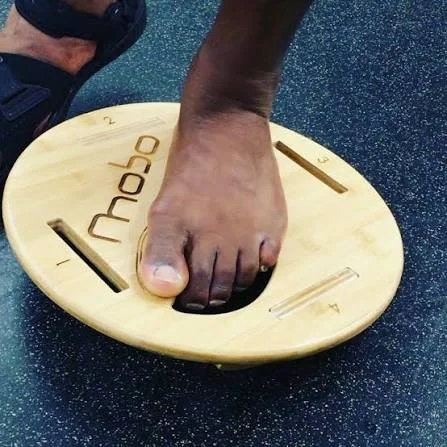
This is where the Mobo Board comes in. Its design includes a cutout for the lesser toes, which takes them out of the equation and forces the big toe to do what it's supposed to: press into the ground and stabilize the foot, ankle, and lower limb.
Compare that to more common balance tools — a Bosu ball, wobble board, or dyna disk. Those tools do challenge your balance, but they don't specifically isolate and reinforce the big toe connection to the ground. You can compensate around them without ever correcting the underlying pattern. The Mobo Board doesn't let you hide that compensation as easily.
The board also has adjustable fins underneath, which let us change the instability challenge depending on the client. That makes it easy to scale the difficulty up or down — a genuine progression and regression tool rather than a one-size-fits-all balance pad.
Three Exercises to Try
1. Single Leg Stance Stand on the board on one leg and focus on pressing the big toe down, feeling it connect and "grip" into the board rather than letting weight shift to the outside of the foot.
2. Lateral Toe Taps From a single leg stance, tap the opposite foot out to the side and back, keeping the standing foot's big toe pressed into the board the entire time.
3. Single Leg Star Squat A more advanced progression — from single leg stance, reach the free leg out in different directions (like points of a star) while performing a small squat on the standing leg, maintaining that same big toe connection throughout.
Who Should Try This
This approach is especially useful for runners and athletes looking to sharpen single-leg control, anyone recovering from an ankle sprain or lower limb injury, and adults prioritizing fall prevention and long-term mobility. If you fall into any of these groups, foot and ankle stability work deserves a spot in your training — not as an afterthought, but as a foundation.
Build Real Stability From the Ground Up
Real single-leg stability doesn't come from just balancing on an unstable surface — it starts with the big toe doing its job. Get that piece right, and everything above it — ankle, knee, hip — has a more stable foundation to work from.
Pure Movement is located in Portage, MI at the corner of Oakland & Centre, serving clients throughout Portage, Kalamazoo, and Southwest Michigan.
Ready to build real balance and stability from the ground up? Book a session with our team, and let's put together a plan built around how your body actually moves.