
October is National Physical Therapy Month, a time to recognize the professionals who help people move better, recover stronger, and get back to the things they love. Physical therapists are movement experts. They don’t just treat pain; they find out why it’s happening and build a plan to fix the root cause, so you can stay active for years to come.
At Pure Movement, we’re lucky to have one of those experts right in our gym. Dr. Kaela Frailing, PT, DPT, brings skill, compassion, and a whole-person approach to every session. Her clinic sits in the back of our space, so she’s able to walk the line between rehabilitation and performance to provide the best quality care when treating the community and assisting our gym members.
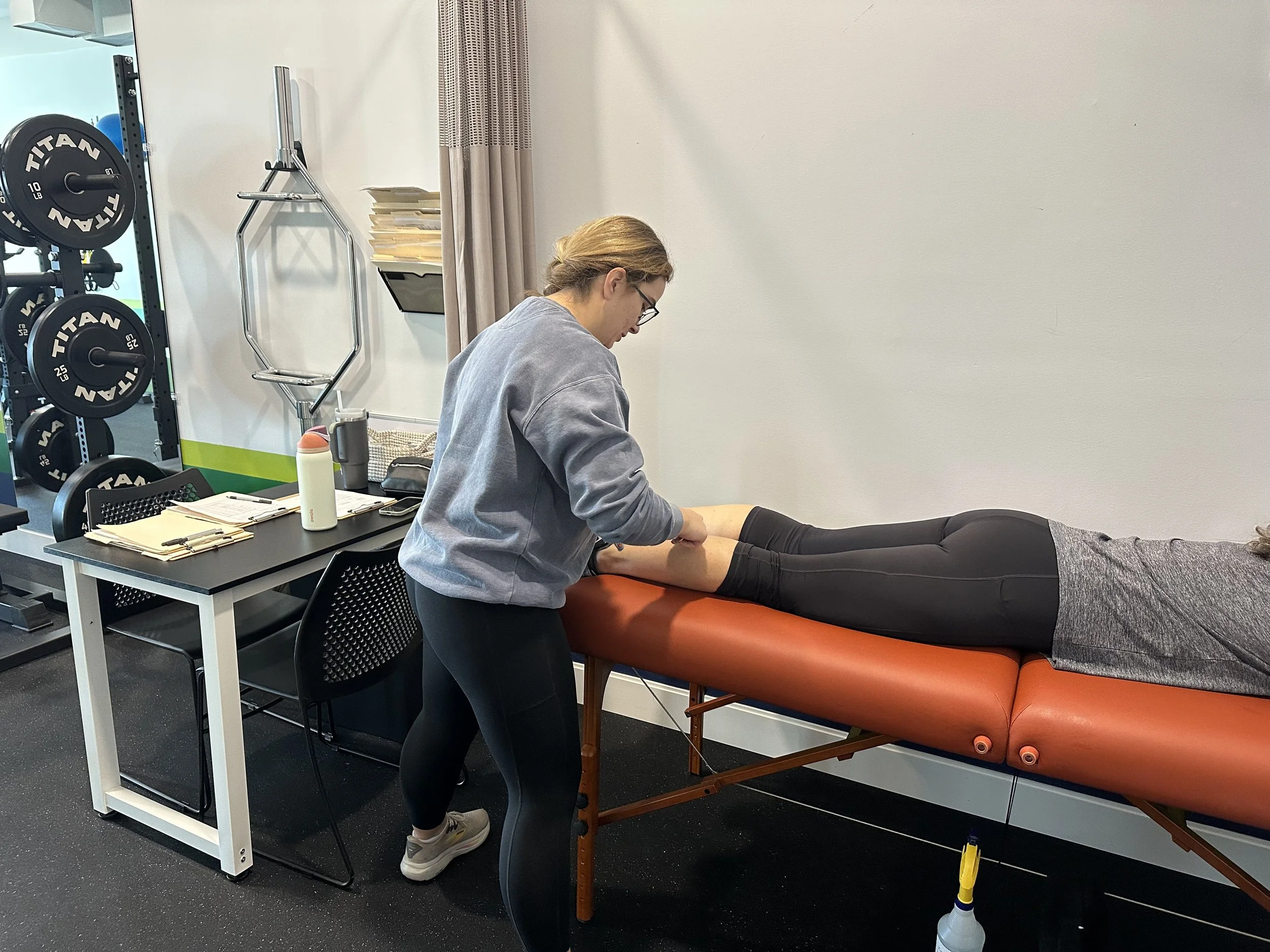
We asked Kaela a few questions so you can get to know the person behind the practice. Here’s what she had to say:
Q: Why did you decide to become a PT? Was there a person, an injury, or a moment where you thought "yeah, this is what I want to do"?
A: “For the longest time I thought I was going to go into med school with the eventual goal of becoming an OBGYN. I ended up deciding to not do that because 1) I am not made for anything greater than a 10 hour shift and 2) I found out how cool of a profession physical therapy is. A lot of my friends on the cross country and track team in college were either going for athletic training or physical therapy. I ended up getting injured quite a few times in training so I spent my fair share of time in these spaces and I really just fell in love with PT as a profession.”
Q: Tell me about your athletic background. What sports did you play growing up and over the years, any injuries along the way, and how did you get into running?
A: “Honestly? I was one of the least athletic kids for the longest time. I dabbled in some summer sports camps in elementary and middle school (things like volleyball and softball), but I never really found something I wanted to stick with. Then right before high school, my best friend convinced me to join the Color Guard for marching band and that was so much fun. I did that for 3 years, but my primary friend group and my partner, Noah, (who I’m still with to this day!) were all big into cross country and track. I swore up and down that I would never become a runner but one day in the fall of my junior year, Noah convinced me to go for a run with him and I ended up joining the track team that spring. Then I trained all summer for my first cross country season, ran a few races with the varsity team, and ultimately got to go on to run XC and track in college at Aquinas in Grand Rapids. It was such a wild ride of how I got there and it’s so fun to look back on that.”
Q: Why did you go deeper into pelvic floor and pregnancy/postpartum care with all the extra training? What did you see or experience that made you want to focus there, and what do you wish more people knew about it?
A: “I could write an entire book on why pelvic health is so important to me, but I’ll try to keep it somewhat brief. I was a gender studies minor while in undergrad and after deciding I wanted to switch from OBGYN to something else, I still wanted to find a way to merge my love for women’s health and physical therapy. I later discovered that pelvic health physical therapy was a thing and it felt like the perfect fit. Personally, I have endometriosis and have experienced a wide variety of symptoms from this as well as undergoing surgery for management of this. As a result I have been able to experience pelvic health PT not only from the practitioner side of things, but also I was a patient myself while in PT school and it just really pushed me to want to go into this field and become the best therapist that I could. Pregnancy and postpartum is just one aspect of pelvic health PT that I love, but I honestly love the variety of patients that I get to treat from this lens - I feel that I really just get to create a special bond with my patients. I wish that more people just knew that pelvic health PT existed! And that the profession has changed so much in the last 10 years. We are more than just kegels!!”
Q: Same question for running and orthopedic stuff. Why did you do the extra CEUs and advanced education there, and what does it let you do for patients that you couldn't do otherwise?
A: “You don’t become a physical therapist without at least a little bit of love for how the human body works and a desire to keep learning more. I honestly take the extra continuing education because there is always so much more to learn and it allows me to widen the skills that I have in order to help everyone that I can.”
Q: Why are you exploring cash-based PT vs. working with insurance? What did you want to do differently for patients?
A: “I have worked in the insurance based world since graduating from PT school and I saw so many situations where insurance was the limiting factor in the patient getting better. Too many times there was a delay in care because the insurance was taking too long to approve more visits or they required a peer to peer phone call where I would have to spend 30-60 minutes justifying to a non-medical professional why my patient deserved care or they would just outright deny patients continued care because they were “doing too well.” I don’t believe that insurance companies should get to override the decision of a skilled medical professional when it comes to patient care. With cash-based PT, I get to do that. The decision for what care looks like is now between myself and the patient, not their insurance company. We get to decide when we’ve reached the goals that we wanted to without having to worry about if the patient is starting to look “too functional.””
Q: What changes when you get a full hour 1:1 with someone? Like what do you get to do that you couldn't in a shorter visit?
A: “The biggest thing about a full hour is that I don’t feel rushed. There is always so much that I want to cover in a session and I don’t want to have to pick and choose what I can do solely based on time constraints. I really value the hands-on aspects of my job and I feel that manual treatments are always best when paired with some form of exercise/active movement either before or after. An hour gives me the time I need to really focus on both parts of this.”
Q: How would you describe your treatment style? If a new patient asked what to expect at their first visit, what would you tell them?
A: “This is such a hard question for me because it really does adapt based on the person in front of me. I would say, especially at the first visit, to expect a lot of questions. I want to spend the majority of that first visit getting to know my patient, not just what brings them in to see me but also their goals and what their life looks like. It allows me to really tailor their treatment to what will fit their lifestyle best. I also try to not overwhelm anyone with too much information from my end on that first visit. My goal is to send you home with 1-2 things to try before our next visit that should start to help you feel better and then continue to develop our plan from there.”
Q: What's one PT myth you'd love to bust, or what would you tell someone who's nervous about coming in for the first time?
A: “Rarely is the solution to stop moving. Unless absolutely necessary, I will not tell you to stop working out, running, gardening, or anything like that. Ultimately, the goal is to create a plan around those things that bring you joy that allows you to continue doing them while we also work on whatever area is causing you difficulty. Sometimes that involves adapting the task slightly, but not typically stopping it altogether.”
Q: What's your worst (or funniest) trail run, race, or workout story? Wrong turns, weather, wildlife, wardrobe issues, anything goes.
A: “I have a lot of these. One of my favorites is from when I ran at Aquinas. My freshman year, one of the first runs on campus, the upperclassmen led us out to a halfway point, taking lots of turns and purposefully trying to go in weird directions. Then, at halfway, the freshman took over and we had to lead everyone back to campus. It’s supposed to be a really fun way to learn the area around campus, but I have never been one to have a good sense of direction. Let’s just say we ended up in not the greatest part of downtown Grand Rapids and the upperclassman took back over that run quite quickly. I also think we ended up running about 2 miles longer than we expected to.”
Q: What's the last book you couldn't put down?
A: “Definitely Yesteryear by Caro Claire Burke. This book has been having a lot of conversation surrounding it recently, and for good reason. Such a good debut novel. I won’t say too much about it because it’s better to go in not knowing too much, but if you like fever dream style books you may enjoy this one!”
Thank you, Kaela, for everything you do for our clients and our community! Your expertise and care make a real difference, and we’re proud to have you on the Pure Movement team.
Pain isn’t something you just have to live with. Whether it’s a nagging knee, a stiff back, pelvic floor concerns, or an old injury that never fully healed, getting answers early can save you months of frustration. With Kaela, you get a full hour of one-on-one time, a plan built around your goals instead of insurance limits, and no referral required to get started.
Dealing with aches or pains? Schedule a free 15-minute discovery call with Kaela to talk through what’s going on and see if PT is the right next step.