
IT Band Syndrome: Symptoms, Causes, and How Physical Therapy Can Help
If you've ever experienced pain on the outside of your knee while running, cycling, or exercising, you may have encountered IT band syndrome. It is a common overuse condition that can make everyday activities and exercise uncomfortable.
As a physical therapist — and a runner herself — Kaela Frailing knows this pain firsthand, both in the clinic and on the trail. She's seen how frustrating it can be when knee pain interrupts training, and she's built her practice around helping runners understand why the pain shows up so they can keep doing what they love, injury-free.
What Is IT Band Syndrome?
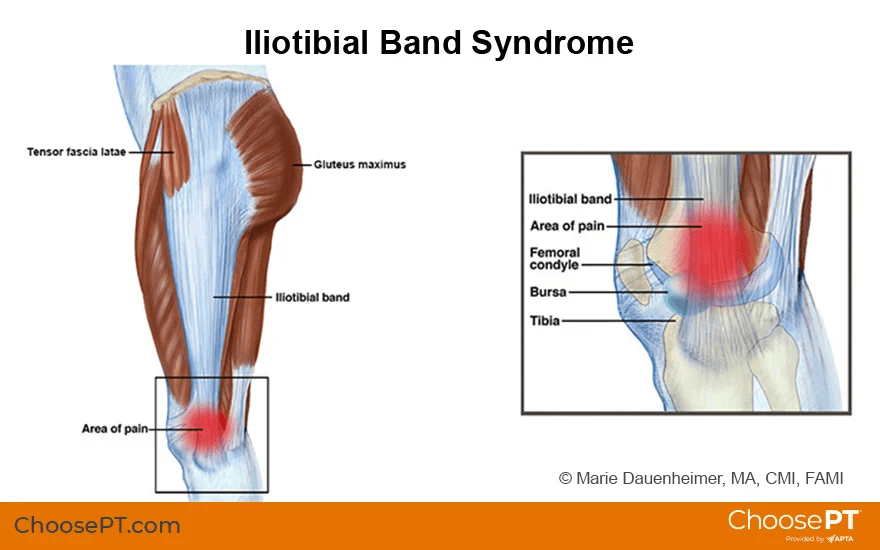
A common misconception is that the IT band (or iliotibial band) is a muscle, but it is actually a strong band of connective tissue that runs along the outside of the thigh, from the hip toward the knee. It does have muscular attachments near the pelvis at both the tensor fascia latae (TFL) and gluteus maximus muscles, helping to provide hip stability. Then the tendon connects down at the lateral aspect of the tibia, just below the knee, helping to stabilize these structures as well.
IT band syndrome typically develops when repetitive activities place increased stress on the tissues around the outside of the knee. It is especially common in runners and cyclists due to the repetitive nature of these sports.
Common Symptoms
Symptoms can vary, but common signs of IT band syndrome include:
Pain along the outside of the knee
Tightness/pain on the outside of the hip
May feel "snapping" of the IT band over the knee as it moves
Swelling at the outside of the pain
Pain that worsens with repetitive movements, such as walking, running, cycling, navigating stairs, or squatting
What Causes IT Band Syndrome?
IT band syndrome is often related to repetitive stress and changes in activity rather than one specific injury. Common contributing factors include:
Increasing mileage, intensity, or training frequency too quickly
Weakness in the hip/glute musculature
Poor lower-extremity movement mechanics (poor running mechanics, impaired patellar tracking, etc.)
Limited mobility in the hip or surrounding muscles
Changes in running terrain, footwear, or training surfaces
Prolonged time spent in one position (sitting, squatting, or kneeling)
Because several factors can contribute, it's important to receive a comprehensive functional movement examination to determine the proper way to address your symptoms.
How Can Physical Therapy Help?
A physical therapist can assess how your hip, knee, and ankle move during activities such as walking, squatting, running, or jumping. This evaluation can help identify factors that may be contributing to your symptoms.
Treatment may include strengthening around the hips, knees, and ankles, improving mobility in these areas, temporarily modifying activities, and gradually progressing back to exercise. Your PT may also address running or movement mechanics and help you develop a training progression that reduces the risk of symptoms returning.
The goal is not simply to decrease pain but to help you understand why the problem developed and build the strength, mobility, and movement capacity needed to return safely to the activities you enjoy.
Want to Learn More? Join Us for a Free Understanding Knee Pain Workshop
IT band syndrome is just one of several knee conditions that can sideline a runner. If you've dealt with knee pain, are ramping up mileage, or just want to build stronger, more resilient knees, join Kaela Frailing, PT, DPT for an interactive, small-group workshop:
Understanding Knee Pain
Tuesday, August 25, 2026
5:30–6:15 PM
Pure Movement, 2050 W. Centre Ave, Portage, MI 49024
You'll learn the anatomy of the knee, the most common causes of running-related knee pain, why knee pain often isn't just a "knee problem," and simple strength and mobility exercises you can start using right away.
Space is limited to 10 participants. Register today to reserve your spot.